
Has it been a year already?

Well, it’s Fathers’ Day, which marks one year since my last post on Tackle. I didn’t mean to stop writing. It just happened.
Part of the reason was that I felt that perhaps I should start writing longer papers that go through the usual peer-review grind. I wrote one with Irina Levit on antizionism as a form of strategic antisemitism, in which we argued that the “antizionism IS antisemitism” response to the denial of this relation by antizionists everywhere was true but would be ineffective. It comes off as defensive, and that’s already a losing proposition in information warfare.
The second idea we tried to convey was that antizionism is expressed at one level by its perpetrators, but at another level, by its instigators. Here, I invoked a distinction I drew 25ish years ago between instigators and perpetrators of the Holocaust. I argued that the instigators tend to play roles that are much less substitutable than the perpetrators. Hence, you can run the counterfactual in which Heydrich or Himmler never existed and still imagine the Holocaust playing out more or less unchanged. But it is much harder to do that with confidence, if only Hitler hadn’t existed. Of course, this will be less convincing to die-hard structuralists, but perhaps it doesn’t matter. The search is for how actors and structural forces fall along the continuum of substitutability. The closer you get to if only not-x, then it wouldn’t have happened, the closer you get to what I mean by the instigator or instigating force. Back to the paper, we argued that effort should focus on understanding the instigators of antizionism because they are the ones that pursue it for strategic reasons. The perpetrators may do it because they’re useful idiots, mentally deficient, irredeemably irrational, or exceptionally envious—pick your psychological deficiency—but it would be wrong—dangerously wrong—to confuse the irrationality of this agent with the calculated strategy of the antizionist instigator.
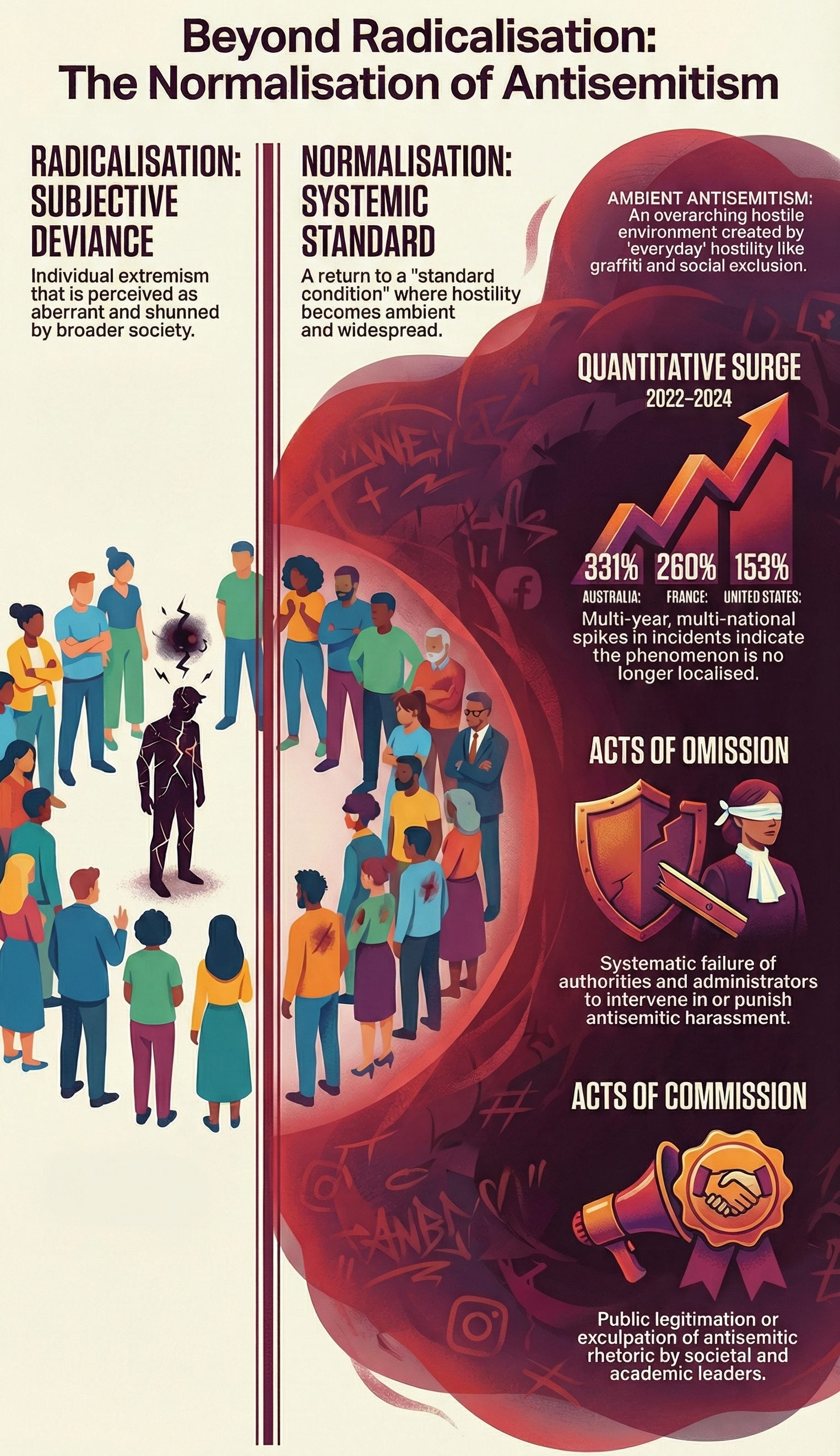
Another paper I wrote focused on the normalization of antisemitism in the West since 10/7. This one was for a special issue on antisemitism to appear in the Journal for Deradicalization. In that paper, now in press, I wanted to take up the issue of whether the spike in antisemitism we’ve encountered since 10/7 is the result of radicalization or normalization. I argued that you can’t have it both ways, unless you’re willing to degrade the concepts so fully that they become indistinguishable. The reason I thought this was important was because one sees both concepts nowadays routinely invoked to characterize what is going on. According to one narrative, radicalization is on the rise and this fuels antisemitism.According to the other, antisemitism is on the rise because it is increasingly normalized within the broader society.
About 15 years ago, I had written a paper critiquing the concept of radicalization. I argued that the concept is inherently subjective and evaluative. One person’s radical is another person’s martyr or freedom fighter. I did not think the construct could lend itself to a scientific—even social scientific— analysis of terrorism and its psychological precursors. From a Western perspective, entire Middle Eastern societies are radicalized. Thus, when over 70% of Arabs in Gaza and Judea and Samaria say in public opinion surveys conducted shortly after 10/7 that they supported the attacks, this is seen as evidence of a radicalized society. But if the society is radicalized, how is it differentiated from a society in which the same attitudes and beliefs are normalized? It isn’t.
So is this just semantics? Does it really matter whether we explain the spike in antisemitism as the result of radicalization or normalization? I think it does. If the spike were the result of radicalization, by definition, it would be a marginalized phenomenon within society. The victims would also be limited, but in fact, most Jews have experienced transient antisemitism in the past few years and they are increasingly experiencing traumatic invalidation in many areas of everyday social life. This is not the pattern of radicalization. It is the effect of normalization of antisemitism where the normalization is not only produced by acts of commission, but by acts of omission. It is the toxic mix of both that produced normalized antisemitism. Thus, when news media perpetually slant stories in ways that vilify Israel (yes, the one and only Jewish state), when police and other authorities do not apply the full force of the law to combat antisemitism, when professional institutions adopt policies that marginalize, if not outright ostracize, Jews (except the slim minority that are themselves antizionists), when university campuses become breeding grounds for antisemitic hate and top administrators stand by and let it happen, it is not radicalization—it is normalization. And normalization is far more pernicious because it signals that the society in which antisemitism openly festers is deeply unwell.
Here’s an AI’s infographic take on that paper:1
Of course, there was also another strange reason I didn’t write, and that was that the number of Tackle’s subscribers climbed almost as quickly, if not more so, after I stopped writing. This, of course, set up a perverse incentive not to write. After all, writing requires time and energy, and I already am writing scholarly papers on a variety of topics, including those just mentioned. Now, dear reader, imagine the thoughts that go through one’s head when one is rewarded with subscribers when he does not write? The fear of waking after a new post only to find an exodus of previously content subscribers is palpable.
But you might say that, surely, I am not so paranoid and vain as to fear such frivolous things! Here you would indeed be quite wrong, for it is only the most self-absorbed, impression-managing intuitive politician who cannot openly admit that readers’ attention in one form or another—be it subscriptions, pledges, likes, comments, reposts or what have you—are writers’ serotonin-spiking candy.
At some point, however, the perverse incentive of being rewarded for not writing gives way to that age-old need to say something.2
Yeah, I don’t think AI is taking over humanity just yet!
And, after all, I do not have a rooftop from which I can easily yell.
Thoughtful as always. Thank you for solid research and academic contributions to this important subject.